Fungus Gnats
How to Get Rid of Fungus Gnats Fast (and Keep Them Gone)
If tiny black flies are hovering around your houseplants, running across the soil, or popping up every time you water—those are almost always fungus gnats. The good news: they’re very beatable. The bad news: if you only kill the adults, they come right back.
This guide gives you a fast “stop the swarm” plan and a long-term prevention routine that actually breaks the life cycle.
Recommended products:

I personally select and recommend every product you see on this page because I believe it truly helps you grow healthier, happier indoor plants, also for convenience and fast shipping, we link to products available on Amazon.
As an Amazon Associate, we earn a small commission from qualifying purchases at no extra cost to you. Every purchase you make helps support our mission to share knowledge, inspire greener homes, and keep the Indoor Plant Care community growing. 🌱


Quick diagnosis: is it fungus gnats?
You likely have fungus gnats if:
- You see small, dark, mosquito-like flies near pots and windows.
- They fly in short, weak bursts and love damp soil.
- You notice tiny translucent larvae in the top 2–3 cm of soil (sometimes with black heads).
- Your plant is mostly fine, but seedlings or delicate roots may look stressed.
- Gnats inside house
Not the same as fruit flies: fruit flies love fruit/garbage; fungus gnats stick to pots and soil.
Why fungus gnats happen
(the real cause)
Fungus gnats don’t appear because you’re “bad with plants.” They appear because the top layer of soil stays consistently moist, which lets:
- fungus/algae grow (larvae food)
- adult gnats lay eggs (they love damp soil)
They often arrive via:
- a new plant from the store
- bagged potting mix (rare but possible)
- open windows (then they choose your moist pots)
The fastest way to get rid of
fungus gnats (48–72 hours)
Your goal in the first few days is to reduce adults immediately while you start killing larvae.
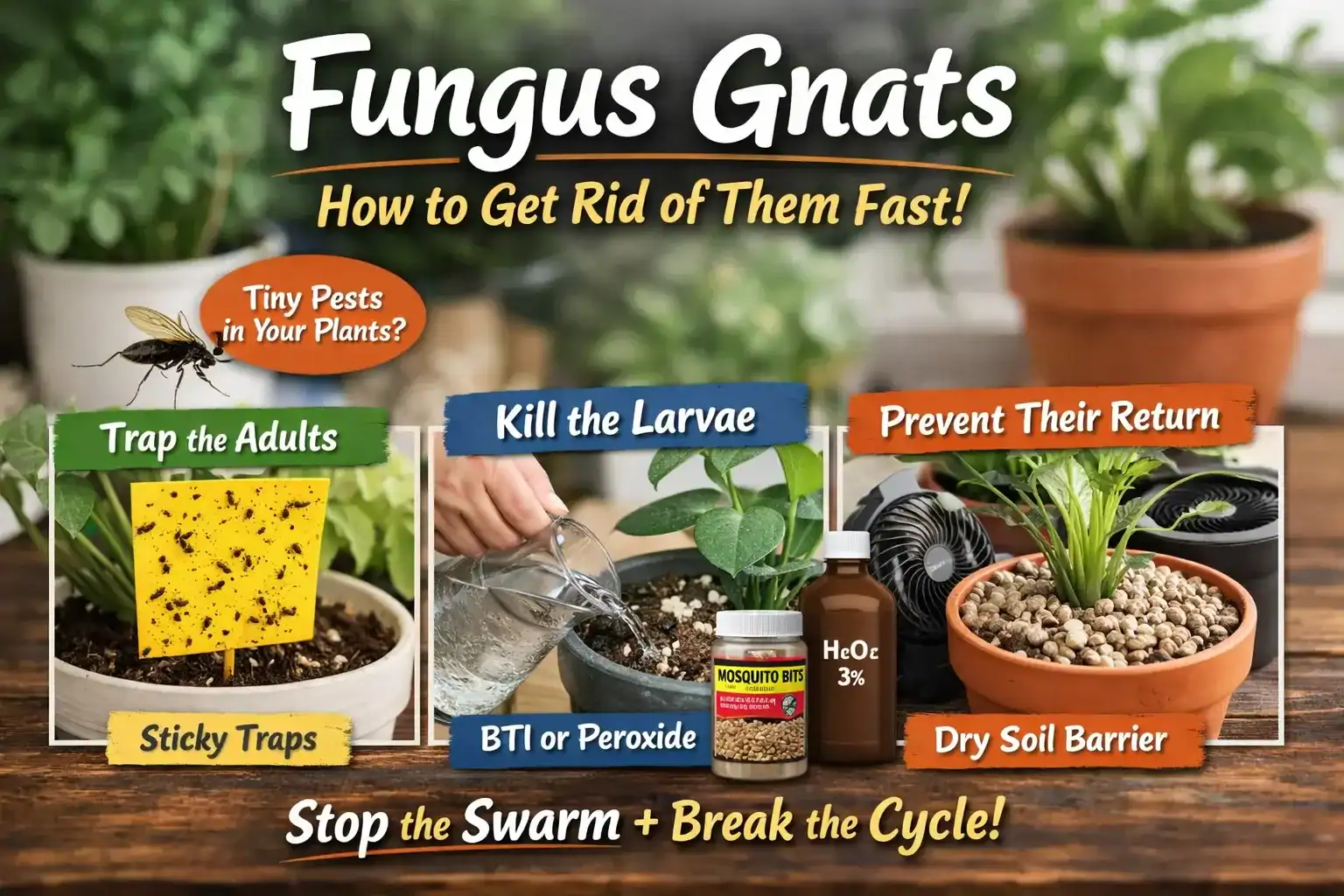
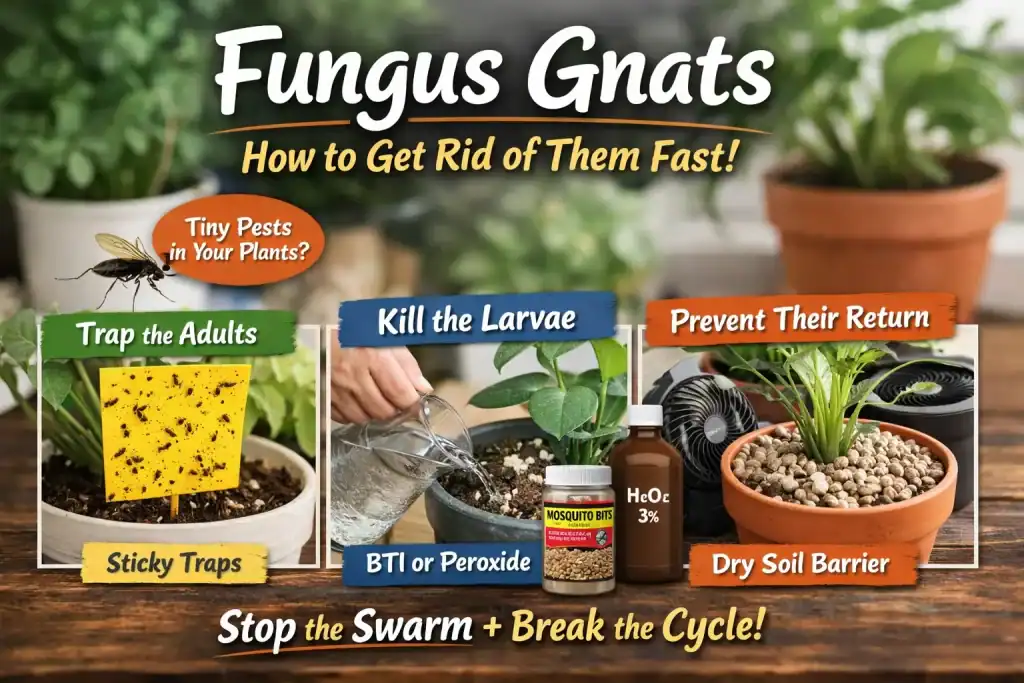
Step 1: Trap the adults
(today)
Use yellow sticky traps (the little cards). Place them:
- 1–2 traps per pot for small/medium pots
- 3–4 for large planters
- keep them right above the soil (not across the room)
This cuts breeding fast because fewer adults = fewer eggs.
Tip: If traps fill up quickly, that’s normal at first. Replace when covered.
Step 2: Dry the top layer
(starting now)
For most houseplants, let the pot dry more than usual:
- Wait until the top 3–5 cm (1–2 inches) is dry before watering again.
Larvae need moisture. Dry topsoil is their enemy.
If your plant can’t tolerate drying (ferns, some calatheas), skip “extra dry” and rely more on the larvae-killer steps below.
Kill the larvae
(this is what ends the problem)
Adults are annoying. Larvae are the source. Choose one main method (or combine) and stick to it for 2–3 weeks.
Option A (best overall): BTI “mosquito dunks/bits”
BTI (Bacillus thuringiensis israelensis) is a biological control that targets gnat larvae.
How to use:
- Soak a piece of dunk in water or add mosquito bits to water.
- Use that water to water your plants as normal.
- Repeat for 2–3 weeks (larvae hatch in waves).
This is one of the most effective, low-drama approaches.
Option B: Hydrogen peroxide soil drench (fast knockdown)
This can reduce larvae quickly, but it’s less “set and forget” than BTI.
Common mix people use: 3% hydrogen peroxide diluted with water (often 1:4).
Water once with the mix, then let the soil dry more than usual.
Notes:
- Don’t overdo it repeatedly.
- Always test on one plant first if your collection is sensitive.
Option C: Beneficial nematodes (excellent for heavy infestations)
Beneficial nematodes (often Steinernema feltiae) hunt larvae in the soil.
- Great if you have many plants or a stubborn infestation.
- Follow the package instructions carefully (they’re living organisms).
Prevent re-infestation
(the “keep them gone” part)
Once you’ve reduced adults and killed larvae, prevention is mostly about making the soil surface less inviting.
1) Water smarter (the #1 prevention move)
- Water only when the plant needs it (not on a calendar).
- Empty saucers—standing water is gnat heaven.
- If your pot stays wet for ages, you likely have a drainage/soil issue.
2) Improve airflow and light around pots
Faster surface drying = fewer gnats.
- give plants a bit more space
- use a small fan occasionally (especially in winter)
3) Top-dress the soil (optional but helpful)
A dry barrier discourages egg-laying.
Good options:
- horticultural sand
- fine gravel
- pumice
- diatomaceous earth (works best when kept dry)
Avoid thick layers that trap moisture underneath. The goal is a dry, airy surface.
4) Fix the soil if it stays wet too long
If your mix is dense/peat-heavy, gnats love it.
At the next repot:
- add perlite/pumice/orchid bark for air
- make sure the pot has drainage holes
5) Quarantine new plants (seriously)
New plant = most common source.
- Keep new plants separate for 10–14 days
- Add a sticky trap immediately
- Water with BTI once or twice during quarantine
The 2-week fungus gnat battle plan (simple and effective)
If you want a no-thinking routine:
Day 1
- Add yellow sticky traps
- Let soil dry more
- Start BTI watering (or peroxide drench once)
Week 1
- Keep traps up
- Water only when top 3–5 cm is dry
- Use BTI water every time you water
Week 2
- Replace traps if needed
- Continue BTI watering
- You should see a major drop in adults
Week 3 (if any remain)
- Continue 1 more week of BTI
- Consider nematodes if it’s still persistent
Common mistakes that make fungus gnats come back
- Only using sticky traps (kills adults, not larvae)
- Watering “a little bit” often (keeps the topsoil moist forever)
- Leaving water in saucers/cachepots
- Treating for 3 days and stopping (eggs hatch in cycles)
- Keeping one “problem pot” untreated (it reseeds everything)
FAQ
Are fungus gnats harmful to plants?
Adults are mostly just annoying. Larvae can damage fine roots, especially in seedlings, cuttings, and delicate plants.
Why do I see more gnats right after I start treating?
Traps make them visible, and drying soil forces adults to move around. That’s normal—stick with the plan.
Will cinnamon kill fungus gnats?
Cinnamon can reduce surface fungus a bit, but it’s not a reliable solution for larvae. Use proven methods (BTI, drying, nematodes).
Can I get fungus gnats from potting soil bags?
Sometimes. Store mixes dry and sealed, and consider BTI watering when using fresh mix.